Wikislicing project gets real – introducing InfoSlicer as a Sugar Activity

{ Posted on Oct 13 2008 by annegentle }
Scissor-style information slicing

Scissor-style information slicing

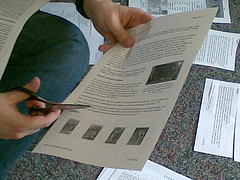
A photo of old school remixing – printing out Wikipedia articles and recombining them. :)

This was a fun learning exercise as part of an IBM Extreme Blue student project creating a Sugar Activity called InfoSlicer.

Instead of using scissors, you can now slice information by downloading Wikipedia articles, editing and remixing them, and reading them online. also uploading edits to Wikipedia (Edited: woops, that was part of our use case and it should work in the future because it was designed with that extension in mind).

Under the covers it is using the Darwin Information Typing Architecture, also known as DITA (dih-tuh), a standard set of DTDs (or schemas) that allow sharing of open source transformations and an open toolkit implementation. See dita-ot.sourceforge.net for more information.

Watch a demo of the InfoSlicer Activity in action here:
http://ca.youtube.com/watch?v=Y0UDRi37MWM

This Activity was part of the Wikislice Project. We met our goal of creating custom curriculum materials from Wikipedia for OLPC but we still have work we want to do to help teachers use it.

I can hear all the librarians and teachers of the world saying together – cool!

Bookmark and Share


10 Responses to “Wikislicing project gets real – introducing InfoSlicer as a Sugar Activity”

  1. Hi Anne,

    One more teacher saying “cool!”. This is not only cool, it is *impressive*. Creating content should be as easy as this activity. Thank you!!!

    Sameer

  2. Annie,
    This is is a killer app! Congrats to all who have worked on it.

  3. Amazing!

  4. Quite impressive!
    Would it be possible that by default it adds a recognition of the authorship? i.e, Wikipedia, article name, date.
    As a classroom teacher (and researcher at heart) I do believe it is important kids get used to indicate their sources. If it were automatic at least kids would get used to see that when they use someone else’s work, it gets credit.

  5. Wonderful application, and video! I agree with Yama, if sourcing (automated endnotes and attribution) were visibly part of this, it would get kids focused on analyzing how, where, and why they arrange elements, focused on filtering and recombining and not just copying. For teachers, of course, it’s a dream. Wow. :-)

  6. re: integrating referencing

    An integration (or perhaps rather an extension) for EndNotes (http://www.endnote.com/) or RefWorks (http://www.refworks.com/) would make this is valuable tool for all student groups – and an excellent manner of introducing ‘journalist’ perspective on the vast online resources.

    I could also see this being used by university students during their thesis write-up, particularly for their initial appraisal of academic knowledge – or “literature review”. Whilst sections might be copied verbatim – with intention of quoting in full (with appropriate reference automagically added), this could also reference modified text that is built up from multiple sources.

    Both RefWorks and EndNote should offer an academic scheme which would allow access at a privileged rate for schools/universities… Perhaps another avenue for development collaboration?

  1. 4 Trackback(s)

  2. 14th October, 2008 « Sayamindu’s Ramblings
  3. SJ’s Longest Now » Infoslicer code released : reading Wikipedia subsets has never been easier!
  4. Sugar on a Stick: Good for Kids’ Minds (and School Budgets) « Computing 4 Free
  5. Les dicos, c’est la classe ! | OLPC France

Post a Comment