Posts Tagged ‘editorial calendar’
STC Intercom - Editorial Calendar progress
Thanks everyone for the great comments and feedback on our starting list of theme and article ideas for STC Intercom’s 2009 editorial calendar. I appreciate that comments are still coming in, from all around the globe. I’m enjoying the international and generational communication we’re seeing, so thanks very much!
We posted ideas and requested feedback on blogs, the STC forum, and tapped Ed Rutowski’s experience and knowledge as well as hearing results from survey data he has gathered over the years. All venues have resulted in view points and reflections that are helping us on our journey to assemble an editorial calendar for next year’s ten issues.
In the weeks since I posted that entry, the advisory panel has met twice. In between the two meetings, we performed what is called a card sort using the web application at websort.net. I thought I’d share our process with you, since I found it fascinating, but also because the card sort was extremely helpful so that we could narrow down and focus the ideas from 50+ to just 10.
Websort is a Web-based card sorting tool, and the site’s intent is to help web designers improve the organization of their site. Panelist Rhonda Bracey had used it previously and thought it would be a good match for our needs. Great thinking, Rhonda!
To create our study, I used a list of keywords created from our brainstorming and invitations to the larger community to give their feedback. I had stored the keywords in a Google Spreadsheet, with one column for the keywords, and a second column for a more detailed description of what the originator meant by that idea or concept. I was able to copy and paste the keywords into the sorting tool, and then create tooltips for participants to see the longer description when they hoovered their mouse over the keyword.
Next, I sent the invitation to participate to the editorial advisory panel using the WebSort tool and the list of email addresses. Whenever a participant completed the study, I could use an RSS feed to be notified. It took me about 45 minutes to complete the study myself.
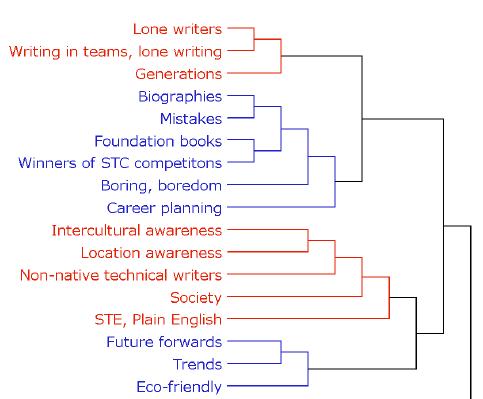
Once everyone had done the sort, I could view the results and analyze them in different ways. One analysis is called a tree view, which I sent to everyone in a PDF file that you can download. The groupings are bunched as if in a tournament bracket, with groups colored red or blue, and it offers a visual representation of how the participants grouped things in common, although the names of their groupings do not appear. You download the tree words list separately.
You can download a spreadsheet analysis tool after the study is complete, and then download and an Excel macro that takes the tree words list and compares it with each participant’s list and groupings. It produces a set of frequency tables for each item, containing a list of the groups in which that item was placed across all the participants.
Before our second meeting, I sent out the tree view PDF file and the spreadsheet with the macro run on the data. During our meeting, we then discussed the results and analysis and seven topics were clearly indicated. Our job then was to ensure that we had three theme-worthy categories and also to make sure that no topic slipped through the cracks or was ignored completely.
We discussed the difficulty in choosing a theme that will have the right content so that any issue of STC Intercom has something relevant to nearly all members, despite knowing that technical communication contains a diverse set of jobs, tool sets, and career paths. Our hope is to produce a set of themes that are relevant and that we’re realistic about recruiting writers for the articles.
We’re still working on the final list and I’ll be sure to share it. STC Intercom’s editor, Ed Rutkowski, is leaving at the end of the month, and we’ll have our list ready for the new editor. Ed has served the Society for eight years and we’ll miss him. He has been great to work with - so best wishes to Ed at his new magazine editor position! If you know a qualified applicant, and STC members are encouraged to apply, review the job description and follow the instructions in the announcement linked from the STC home page.
STC Intercom - themes and advice wanted
I’m quite flattered and humbled (and more than a little bit intimidated) to serve as leader on the STC Intercom advisory panel for this coming editorial year. We’re five people from different backgrounds and perspectives, tasked with preparing 10 themes for issues by August 2008. We’ve got academia, consulting, work-aday, future thinkers, and the only gap in our panel would be someone with regulatory or government limitations, er, opportunities for their content (applications for the open position, or suggestions for contacts are welcome!)
At our first informal breakfast meeting, Ed Rutkowski, Tom Johnson, and I brainstormed themes and topics for articles. Here’s our starting long list that we’ll work from and add to - and please, feel free to add to it in the comments!
Ideas
- Agile
- Security (such as online identity and blending that with our user assistance systems to provide online community features)
- Biographical or semi-celebrity feature articles, such as “how did I get to be JoAnn Hackos or Jared Spool or… fill in the blank”
- Mobile and wireless effects on tech comm
- Gadgets and devices (get nostalgic about the Selectric? and then move towards the gadgetry of today, hardware or software? Roll up keyboards?)
- Outsourcing, crowdsourcing, friendsourcing
- Eco-friendly or green themes, how do you save the planet as a tech writer?
- Career planning
- Location awareness - cultural sensitivity but also could be online help that knows where the reader is located geographically or awareness of where a cell or mobile phone is located
- Messaging and brand awareness
- Collaboration
- Virtualization
- Future forwards thinking, not just trends and trendsetting but really out there like flying cars kind of concepts
- Alternatives to online help
- Social networking
- Usability for online help
- Audience considerations, especially in industrial settings, high risk settings, regulated settings
- Patterns - design patterns are used in object oriented programming but they started with architectural patterns (entry way is a solution to the problem of entering a building and a room and so on.)
I’ve also identified some areas of deficit where I’m not quite sure how to fill the void. One is, there are no Gen Nexters voices that I know of in STC yet, and I’d really like to change that somehow with STC Intercom. Gen Nexters are age 18-25, just starting out in our profession. Since now is the first time in history that four generations are in the workplace, I’m striving to find those tech writers who are just starting out but have a passion for their career choice. From what I’ve read, Generation Next is made up of 18-25 year-olds (born between 1981 and 1988). Generation X (that’s me!) was born between 1966 and 1980 and ranges in age from 26-40. The Baby Boomers, born between 1946 and 1964, ranges in age from 41-60. Finally, those over age 60 (born before 1946) are often called the Greatest Generation. Please, contact me if you are of Gen Next or could tell me of someone who I could talk with for input on our themes and perhaps contributing to an issue.
Subscribe to RSS

