Posts Tagged ‘training’
Notes from April 2008 Central Texas DITA User Group meeting
Better late than never, I suppose. I’ve had these notes on my hard drive and want to post them to the cloud of my blog.
John Hunt, DITA Architect in the Lotus Information Development Center at IBM and DITA Learning and Training Content Specialization SC chair, presented Using DITA Content for Learning Content Development at the April 2008 Central Texas DITA User Group meeting. He gave an overview of work being done on the new Learning and Training Content specialization that will be part of OASIS DITA 1.2 release. (Updated to add: see DITA Learning and Training Content Specialization SC for additional information and download links for the Open Toolkit Plug-in that contains the approved specialization.) He then followed up with a live demonstration of creating, assembling, and delivering topic-based learning and training content, delivered both as a SCORM-compliant package and as simple XHTML.
In the room we had about 20 Austin attendees and on the phone, a handful more in Ann Arbor, with John Hunt, our presenter, presenting from Massachusetts. He has worked with DITA for 9-10 years, but interestingly, has met Don Day in person only once.
Learning specialization will become a DITA standard in next OASIS release.
John led with a very recent newspaper article, about re-creating the Jefferson Library – “Re-created Library Speaks Volumes About Jefferson” Amy Orndorff, Washington Post, Apr 11, 2008 (John’s talk was on the 16th!) The library was given to the Library of Congress for $24,000 in 1815. Jefferson had created his own taxonomy - memory, reason, or imagination. Automatically, John wondered if you could parallels to reference, concept, or task. Ah ha!
Fascinating - Jefferson did mashups of books by tearing them apart, even different language books, and then would bind them into new books – reassembly of content 200 years ahead of his time.
Industry context – trends – smaller, faster, leaner for creating and delivering training content.
Content as reusable learning object helps… RLOs (Reusable Learning Objects) were developed at Cisco in the 1990s, similar to legos as building blocks – different structures with the same set of Legos.
LCMS (learning content management system) came into being.
Training can move from a “craft” approach to a DITA content approach, standard.
Craft = every deliverable unique, every context one-of-a-kind
Craft = presentation oriented, labor intensive
DITA = content and deliverables have consistent structures and patterns, so available for reuse and repurposing
DITA = collaboration and reuse becomes the norm
IEEE LOM (Learning Object Metadata) is a standard for the learning metadata domain. See ltsc.ieee.org/wg12/20020612-Final-LOM-Draft.html
Build maps + specialized processing = generated learning deliverables such as tutorials, courseware and e-learning, ILTs, SCORMs=mandated for training delivered to the U.S. Govt. (Dept. of Defense), Textbooks. In case you’re wondering, SCORM stands for Sharable Content Object Reference Model - SCORM is a set of specifications created by the Advanced Distributed Learning initiative (ADL). The ADL website has that SCORM runtime freely available, see www.adlnet.gov/downloads/.
Learning objects contain:
- Instructional objects: overview, content, summary, assessment
- Informational objects: concept, task, reference, also known as Facts, Concepts, Procedures, Principles
5 new DITA specializations as learning types – learningPlan, learningOvereview, learningContent, learningSummary, learningAssessment
Midnight at the OASIS – 32 members on the sub-committee, working drafts, Lang. Spec available for inclusion in DITA 1.2 (Nov 13, 2007)
Specializations of 5 topic types.
Also, three domains are available:
- Learning interactions domains – open question, true/false, single select, multiple select, matching, sequencing, hotspot.
- Learning map domain – learning objects and groups, makes learning content available for use in any DITA map
- Learning metadata domain – makes learning metadata available for use in learning topics and maps.
What does DITA bring to learning content?
Consistency all around (content, processing, delivery)
Can grow as DITA grows – add a Flash object
DITA vision – a platform for collaboration
DITA specialized tags contain “lc” for learning content – lcAudience, lcObjectives, lcDuration, lcPrereqs, lcChallenge (instructions follow that address that challenge), and so on.
Manifest file informs the navigation that is then imported inside the zip file into a sample run-time environment – Advanced Distributed Learning. Has Suspend and Quit buttons, as well as Previous and Continue buttons. Assessment section has questions, true and false with javascript that lets you find out if your response is correct or not.
He showed an embedded Youtube video using the DITA object tag within the Summary object. See Double bonus slide for embed code.
Q: Are you re-inventing the wheel with DITA since scorm and ilm are already standards.
A: Scorm is a packaging and delivery standard. Scorm is silent with regard to content.
Eliot Kimber, Really [ ] Solutions, uses the DITA solution for practice test books for each states – remapped element names to new element names and he gets all the SCORM online assessments pretty much for free because he’s using DITA. Nice.
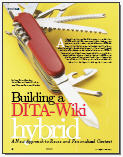
Building a DITA-Wiki Hybrid
The April 2008 issue of the STC Intercom magazine is dedicated to DITA (Darwin Information Typing Architecture).
I’m pleased that the Building a DITA-Wiki Hybrid article that I co-authored with Lisa Dyer and Michael Priestly is available online for free to anyone, STC member or non-member. The article discusses these three ideas for merging DITA and wiki technologies:
- DITA Storm, an online DITA editor with an edit button on each page. While it’s not quite a DITA wiki, it seems like it could become one with some RSS notification and comment or discussion ability on each page.
- Wikislices are a cross-section of a wiki such as Wikipedia, currently created with school curriculum in mind. Michael Priestly and I are working on a team to find ways to use DITA maps to manage and build wikislices.
- Lisa Dyer has implemented DITA as a single-source with wiki as output for a documentation site housed behind a Lombardi customer support login.
I’d love to hear your comments on the article here and any other ideas you have seen for a DITA-wiki hybrid.
April 16 Central Texas DITA User Group meeting
From http://dita.xml.org/book/central-texas-dita-user-group
Using DITA Content for Learning Content Development
John Hunt, of IBM, will give a presentation regarding the use of DITA for learning content. He’s been working on a new Learning and Training Content specialization that will be part of OASIS DITA 1.2 release. If you’d like to do a little pre-work, check out this article about using XML (such as DITA) for learning content: http://www.ibm.com/developerworks/xml/library/x-dita9a/

Presenter
John Hunt, DITA Learning and Training Content Specialization SC chair. John is also DITA Architect and Learning Design Strategist in the Lotus Information Development Center at IBM.
I’m also looking forward to Mike Wethington’s presentation to the DITA user group for the May 21 meeting, where he will talk about Agile development and its affect on technical communications. Mike’s the manager of technical communications at Troux Technologies here in Austin.
How to sign up for BSM International Airport Simulation
Sign up for the BSM thrill ride is a few clicks away.
I thought I’d offer some sign up information for the BSM International Airport Simulation I wrote about yesterday. The BMC education site has other locations as well that you can get to with a few clicks. Class details for U.S. locations. Click the “Change your country” button to get information for other locations.
And don’t forget to check out the movie clip! (.wmv file)
The catering’s down! Flights can’t take off!
BSM International. Where we all get to stare at fancy mock network diagrams, solve logic puzzles, and pretend to feed hungry airline passengers.
Ah, yes. Atwell Williams’ podcast brings back memories of the BSM simulation course.
A few weeks ago, I also stumbled across this review of our BSM International training class. The article is titled ” Riding the Fright Simulator” and it’s a first-hand account of the BSM International airport simulation course that BMC offers that helped me understand the connections between IT services and the IT Infrastructure Library (ITIL), a common set of standards first developed by the UK government. I know I sure learned a lot there.
Here’s an excerpt from the article, which absolutely nails the way you feel during the course:
Clive Ford was looking forward to a quiet day at the office. After all, there was nothing complicated about the outfit he was running — just an ordinary four-terminal international airport.
But then all hell broke loose. The sky started falling, the wheels were coming off and he knew it was going to be one of those days.
The airport went ballistic, he recalls. The radar tower malfunctioned, emergency services were out of control, poisoned food was being loaded on to aircraft, the sky was dark with banked-up planes and the media were hammering on his door.
As soon as one problem was sorted, another slammed into view. So far no one had been hurt, but it seemed like time would soon take care of that. And meanwhile the crises were eating dollars — millions of them.
All rattling good fun, Mr Ford says in retrospect. The best day’s training course he has ever attended.
This course is a great introduction to why the heck you’d want to manage your business services through IT technology. I won’t give away too much of the course, but I will brag that my group was one of the first to come up with a display board for a knowledge base. Leave it to the tech writer to be excited about a fake knowledge base. Solving problems efficiently was actually an adrenaline rush, which is suprising, since the course was also a first introduction to BSM and ITIL for me.
Subscribe to RSS