I could only attend Non Profit Bar Camp Austin in the morning, but it was quite enjoyable. Bar Camp is definitely one of those meetings where the conversations had between the sessions can as informative as the actual sessions.
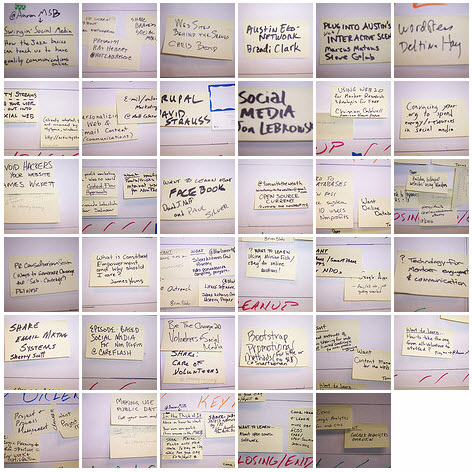
I arrived and signed in and was standing in front of the board right when the orientation ended – and suddenly was surrounded by bar campers looking at the board with me. There was a good variety of topics – updated to add a link to the Flickr photo set with pictures of all the Post-it notes on the board and screenshot of the set.
Austin – experiencing community in the Open City
I decided to first attend a session called “Plug into Austin’s Web/Interactive Scene” with Austinites Steve Golab and Marcus Mateus. They had a presentation talking about the connections we can make in Austin that may not be available in other cities. Austin has a unique vibe, with slogans like “Keep Austin Weird” and events like SXSW Interactive. We support the creative class as described by Richard Florida quite nicely. In Austin it’s cool to be smart, and we are the chosen location for over 6,000 non profits. They’re active in the Bootstrap Austin community. I learned that “Experiences make us happier than possessions” from a CNN article, after they introduced the concept of an Experience Economy. We talked about some of the experience-centered businesses in Austin, from Alamo Drafthouse, a movie theater that serves food and drinks during the flick, to Groovy Lube, an automotive shop with a groovy vibe, After another person’s comment that where you’re sure to be serviced by a hippy-type mechanic at Groovy Lube, about I wondered aloud if the employee experiences is just as important and part of the branding as much as the customer or participants experience. I think Zappo’s is a good example of an employee’s experience mattering as much to the brand as the customer. So, can nonprofits offer experiences? The speakers suggest you could aggregate communities to make a “scene.”
Google Analytics demonstration
For the next session, I ended up offering to demonstrate Google Analytics – someone had put up a Post-it with “Want: Google Analytics Overview” on it for an 11:15 slot, and at 11:14 I decided to volunteer. 🙂 At first it was just me and one other person, but then at least a dozen people joined us. One woman from Settlement Home, was able to demonstrate their Google Analytics implementation. She worked with Trademark Media to get their tracking codes set up. She was able to pull up her Dashboard and show the last month’s worth of visitors and so on. We walked through the various areas of Google Analytics – Visitors, Traffic Sources, Content, and Goals – with stories from many of the participants about what has worked well for them. I especially liked the funnel visualization for tracking the completion of a volunteer application. Our Internet connection was flaky for the first 10-15 minutes, but Chris Boyd, who works at Midas Networks, the ISP for my site, by the way, got us up and running.
One of our discussions was about trying to find out what to measure. One non profit had just started using Google Analytics. With non profits, I believe the goals aren’t always about conversions into sales. The prospects turn into clients or donors or volunteers, instead of customers who make a purchase. So after the session was over, I gathered these thoughts about persona-based goals for websites and tracking.
Personas are profiles of people who connect with your organization. They can be highly detailed, are profiles of imaginary people who mimic real-life people that you know, and are captured in a short report typically. I think that personas would make sense for figuring out the goals you have with web analytics and tracking. Based on looking at Any Baby Can, for example, you may have three personas: donors, volunteers, and clients. They’re going to know way more than I do about their goals, naturally :), but here are some ideas:
Donor persona – some donors want to remain anonymous, is your pathway through your web content giving them that ability? Or if they are the opposite donor type, and want recognition for their contributions, can you track goals on your website that help with that?
Volunteer persona – What are some other goals that a volunteer wants to complete when they come to your website? Do they have a certain day of the week free and want to find opportunities for that day? Did they attend another event and want to find related opportunities?
Client persona – She may be using a public computer, are there particular pathways or goals you can outline and measure? Is the website useful not just for finding information as a potential client, but how is it serving current clients?
These are likely simplistic, but I wanted to share – I had one of those “oh, shoot, I could have described personas” moments after I left bar camp. 🙂
At the very end of the session, I mentioned that I just learned about negative keywords. These are keywords that you use in Adwords campaigns to make sure that your ads don’t show for search queries containing that a certain phrase. That way, people only click through on specific keywords, not related keywords that may not be a good match. A good negative keyword example for Settlement Home (if they started an AdWords Campaign or a pay-per-click campaign), for example, would be “foster dogs” to make sure people looking to foster dogs rather than children not see their ads about foster homes. One non profit was going to apply for an AdWords grant, so hopefully she’ll learn about negative keywords through their strong education program.
Keynote speaker – Holly Ross from NTEN
While I didn’t get to stay for the keynote, the Twitter feed for #npocamp during Holly Ross’s remote keynote was great to follow. One of the more interesting points to me that she made that was tweeted about is that there’s a huge increase (like 600%?) in unstructured data. These are the scattered conversations and communications happening all over the Internet, apparently. How can non profits analyze or monitor unstructured data? Two suggestions came from the person I sat next to in the first session, Gregory Foster: Scout Labs and Radian6.
Summary
What a great way to spend a Saturday morning with energetic, positive people making a difference for people especially using technology and communities. A bar camp, with its unstructured format, was a perfect match for this group.